




There's a particular kind of November that most of Europe accepts without question.
Grey by three in the afternoon. A coat that lives by the door. The slow realisation around the second week that you haven't seen proper sunlight in days and probably won't until March.
We've decided that's just what November is.
It isn't. It's what November is where we happen to be standing.
Not a beach island
The first thing to understand about Madeira is what it isn't.
It isn't a beach destination. People arrive expecting the Canaries and find something stranger and considerably more interesting.
Madeira is a volcano that rose out of the Atlantic and never apologised for it.
Peaks that push above the cloud line, so you can stand in full sunshine looking down at what appears to be a white sea. Ancient laurel forest, laurisilva, that has been growing since before the last ice age, so old and so still that UNESCO protects it.
And the levadas. Hand-cut irrigation channels running for hundreds of kilometres through the mountains, built centuries ago to carry water from the wet north to the dry south. Today they're among the most extraordinary hiking trails anywhere in the world, running flat along cliff faces and through tunnels and into forest that doesn't look real.
There are waterfalls you walk behind. Volcanic rock pools filled directly by the ocean.
It's an island that rewards curiosity rather than sunbathing.
The November advantage
Here's the practical part.
While most of Europe is going dark and cold, Madeira holds a steady 20 to 22 degrees through November.
Not hot. Pleasant, in a month when pleasant feels like a luxury.
And crucially, quiet. The summer crowds are gone, the levada trails are empty, and the light goes soft in a way that makes everything feel slower.
There's a reason this island has quietly become one of the most loved places in the world for people who work remotely, and it isn't only the weather or the internet. It's that Madeira makes you feel physically awake in a way a city never quite does.
Why the host matters more than the island
We could stop there and the island would sell itself. But that would miss the point of what we actually do.
The trip we're running in November is led by Maximilian Ludwig Kohm.
Maxi is German by origin, but he's spent recent years in the mountains of Monchique in the Algarve, looking out over Europe's last wild coast, running nature-immersive retreats and building holistic coliving spaces for people who want to live and work differently.
He's been hosting since 2021. Before that, several years in India, mostly in Himalayan jungles and ashrams, learning from traditions considerably older than anything in Europe.
He describes what he took from all of it in one sentence:
When the right people align in the right place, the energetic potential for powerful shifts opens up.
That's a slightly unusual thing to find in a trip description. It's also, in our experience, completely accurate, and it's the thing we've been trying to build deliberately for six years.
What a day actually looks like
Most mornings open with movement.
Maxi is a holistic personal trainer, so this isn't a generic yoga class. It's functional stretching, mobility, breathwork, meditation, sometimes QiGong, adapted to whoever shows up and how the room feels that morning. Soft or intense depending on what's needed.
It's entirely optional, always. But as he puts it, how you start the day decides most of it, and after one session most people feel the difference.
Then everyone works. Terrace, garden, big table, poolside, or your own room. The pace is calm, and nobody is performing productivity for anybody else.
And when the laptops close, the island opens.
Some days that's a levada hike into forest so green it looks edited. Some days it's driving up to Pico do Arieiro before sunrise to watch the light come over a sea of clouds. Some days it's Funchal, the old town, the market, a glass of poncha with people who have been making it the same way for fifty years.
And some days it's nothing at all except the pool, the view, cooking together, and long evenings where nobody checks the time.
The house
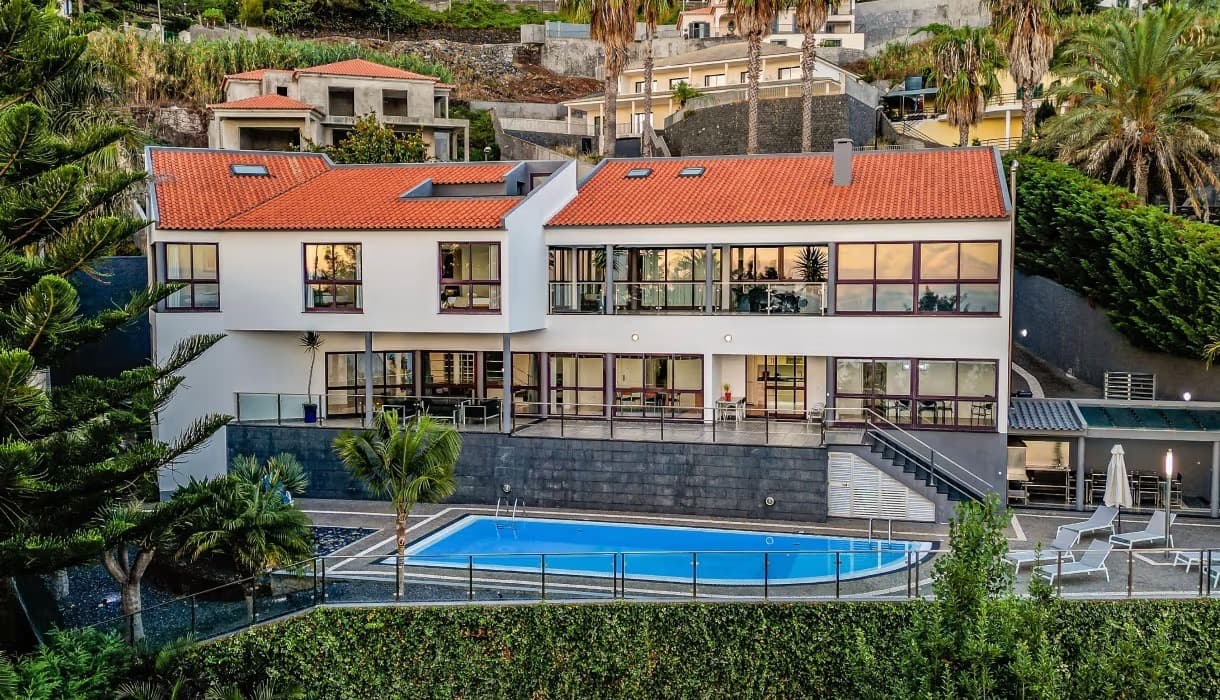
A 450m² property in the hills above Funchal.
Seven bedrooms, so there's genuine space and privacy. A private 14 metre pool. A garden, a BBQ, a gym, a play room, and sea views from the terrace. A large fully equipped kitchen, which matters here more than usual, because Maxi cooks.
Plant-based, big bowls, real food, the kind that fuels rather than fills. His own warning to participants is that they may leave rather more curious about vegetarian cooking than they arrived.
Sixteen kilometres from the airport. Twenty minutes from Funchal. Far enough up the hill that mornings are silent and the view runs all the way to the ocean.
Who this is actually for
In Maxi's own framing: people who work remotely and want nine nights somewhere that genuinely moves them. People who like nature, or suspect they would if they spent proper time in it. People who want a small group who are building something and living intentionally.
And people open to starting their days slightly differently than they do at home.
You don't need to be into wellness or spirituality. You just need to be genuinely curious.
The wider point
We keep coming back to the same principle. The destination matters, but it isn't what changes anybody.
What changes people is a small group, a defined stretch of time, somewhere that interrupts the usual context, and somebody whose job is to hold the room together.
Madeira happens to be an extraordinary place to do that in November. But if it works, it'll be because of who's in the house, not because of the volcano outside it.✌️