




WiFi Tribe is one of the best known names in this space and has been running for years. If you have been researching ways to work remotely alongside other people, you have almost certainly come across it.
We get asked how we compare... Here is a fair answer.
The short version: WiFi Tribe is a membership community you join. Feel.Travel is a curated trip you book. That difference runs through everything else.
How WiFi Tribe works
WiFi Tribe is built around what they call Chapters, where a group of remote workers live and work in the same destination together. Chapters run for several weeks, with options of four, six or eight weeks, and groups are typically larger, in the range of ten to twenty five people.
To join, you apply and are accepted, and you need an active annual membership, currently listed at $490 a year. The membership gives you access to book Chapters and to their global Slack community.
Chapters are paid separately. Each booking involves a deposit, and they run a tiered pricing system: as you complete more Chapters you move through membership circles, Member to Nomad to Citizen to Veteran, and the price of future Chapters drops. You can also buy deposit bundles upfront to jump straight to the lower tiers.
It is a genuine community model. The longer you stay and the more you travel with them, the cheaper it gets.
How Feel.Travel works
No membership, no annual fee, no tiers to climb.
You pick a trip, you book it, you go. The price shown is the price.
Trips run nine to fourteen nights rather than four to eight weeks. Groups are always under fourteen people. Each trip has a TripLeader whose only job, for those days, is that specific group in that specific house.
And we decide who joins… Every trip is put together rather than filled.
Group size is not a detail, it is the product
This is the difference people underestimate most, so it is worth being precise about what actually changes.
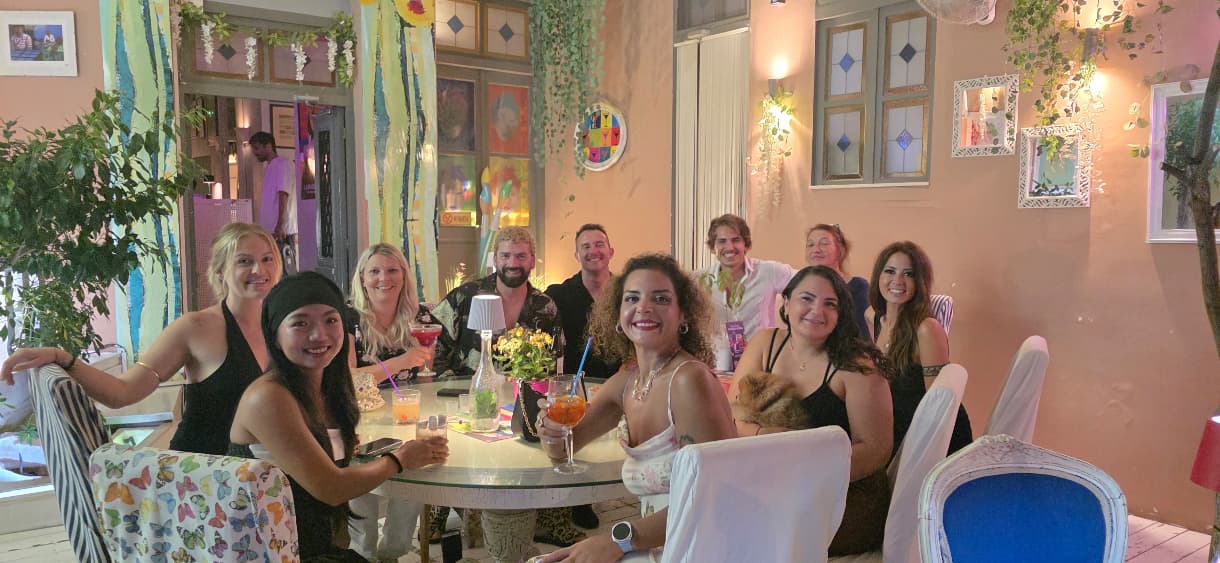
Under fourteen people, there is one table.
Everybody eats together. Everybody is in the same conversation. There is no main group and no overflow, because the house physically does not produce one.
Above roughly fifteen, something different happens, and it happens every time. The group splits. Not out of unkindness, just arithmetic: you cannot hold a single conversation with twenty people, so three or four smaller circles form within the first few days. Usually they harden. And there are always one or two people who did not land in any of them, who spend the trip pleasantly on the edge of something.
With a larger group you also will not properly know everybody. You will know six or seven of them and recognise the rest. In four weeks that is still a good time. But "I know everyone in this house" and "I know some people in this house" are genuinely different experiences, and only one of them is available to you below fourteen.
The trade-off is real and we will state it: a bigger group gives you more variety and a better chance of finding your particular person. A smaller one gives you depth with everyone and less choice. We chose depth deliberately.
Curated, and what that actually means
"Curated" gets used until it means nothing, so here is the concrete version.
We are not trying to sell every seat to whoever arrives first. We look at who is coming on each trip and we think about the mix: how people work, what they are looking for, whether the group will balance. On some trips we speak to people before confirming them, and we do say no.
It means a group never ends up being the nine people who happened to click buy. It is assembled.
With an application-and-membership model, the vetting happens once, at the door of the community. After that, Chapter booking is largely self-selecting. That is a reasonable design for a community that wants to grow and stay open to its members. It is a different thing from composing each individual group.
Length: four weeks versus under two
Four to eight weeks in one destination is a serious commitment. For people with full location freedom it is wonderful, and you get to know a place in a way ten days cannot touch.
But it excludes an enormous number of people. Anyone with a team expecting them in a time zone. Anyone with a partner, a lease, a cat. Anyone whose employer tolerates remote but not disappearing.
We built around nine to fourteen nights deliberately, and not only for access. In our experience the intensity peaks somewhere in the second week. The group has fully formed, the jokes exist, the honest conversations have happened. Beyond that it does not keep climbing. It levels into something more ordinary, which is pleasant, but is not what people came for.
So the length is a design decision, not a limitation. Reasonable people disagree, and the four week format clearly works for a lot of people.
Someone whose job is the group
On a Feel.Travel trip there is a TripLeader in the house the whole time.
That is not a guide and not an organiser. It is the person who makes the introductions on night one, who notices on day four that somebody has gone quiet, who sorts the thing that goes wrong before anyone else has registered it, and who knows the area well enough that the group ends up somewhere locals actually go.
Community-led models rely more on the group making its own weather. Often it does, especially with people who have travelled this way repeatedly. But it is left to chance in a way we are not comfortable with, because the difference between a good week and a transformative one usually comes down to one person paying attention.
The real decision: commitment shape
The membership model rewards commitment. If you are going to spend a significant part of the next few years living this way, a community you belong to is genuinely valuable. You build relationships across destinations, the Slack channel is full of people which some of them you have met.
If that is your life, that model is built for you and we will say so honestly.
The trip model rewards trying. If you have a job, a flat, a life you are not dismantling, and you want to find out whether this suits you at all, paying an annual fee before your first trip is a strange place to start.
Most people considering this for the first time are not sure they will like it. A standalone trip lets them find out for a few hundred euros and ten days.
Price transparency
With a membership model, your total is the annual fee plus the Chapter price, and the Chapter price depends on how many you have done and whether you bought deposits in bulk. It can work out well for frequent travellers, and it takes some reading to work out what your first year costs.
With us, the price on the trip page is the price. One number, no tiers, no prerequisite purchase.
That is simpler. It is also less rewarding if you travel constantly, since we have no loyalty discount structure to bring your price down over time.
Who should choose which
Choose WiFi Tribe if you have real location freedom, you want several weeks in each place, you want a larger group with more variety in it, you want a long-term community spanning destinations, and you will travel often enough that the membership and tiered pricing pay off.
Choose Feel.Travel if you have a normal amount of time, you want to try this without joining anything, you want a small group where you will actually know every person in the house by the end and properly connect with, or you want a specific trip rather than a lifestyle.
And honestly: some people do both. A standalone trip is a low-risk way to find out whether group remote work suits you at all, as well as to build real connections with like-minded people. If you love it and your life allows more, a membership community is a logical next step… but of course with its pros and cons.
One thing they share
Both formats exist because of the same problem, which is that remote work quietly removed the thing that used to hand adults their friendships.
School did it. University did it. The office, for all its faults, did it. Working from your kitchen does not, and most people have not replaced it with anything.
Whatever you choose, choosing something is the point.
If you want to try ours
We will be straightforward about why we think a Feel.Travel trip is worth your first attempt, and you can weigh it yourself.
Nothing to join. No membership, no annual fee, no tier to work up. You book one trip at the price on the page. If you never come back, you have lost nothing.
Under fourteen people, always. One table, one conversation, and you finish the trip properly knowing everyone in the house rather than six of them.
Someone whose job is the group. A TripLeader is in the house the whole time, making the introductions, noticing when somebody has gone quiet, and getting the group into places that visitors do not usually find.
Groups that are composed, not just filled. We look at who is coming on each trip and think about the mix. Sometimes we speak to people first.
Nine to fourteen nights. Short enough to fit a real job and a real life, long enough that by day four nobody is performing any more.
And a lot of our trips are not confirmed until the group forms, which means you can usually reserve a place with no deposit and nothing to pay while you decide.
That last point is the honest answer to the hesitation most people have, which is not money. It is committing to a date months away and not knowing whether it will suit them.
If you want to talk it through before booking anything, message us on WhatsApp or give us a call. We will tell you honestly whether a particular trip is right for you. Some people come away from that conversation and book. Some decide it is not their thing, which is a perfectly good outcome.
FAQ
How big are Feel.Travel groups?
Always under fourteen people. That is a deliberate cap: below fourteen the group stays one group, with one table and one conversation, rather than splitting into smaller circles.
Do I need a membership to travel with Feel.Travel?
No. There is no membership, no annual fee and no application tier. You book a trip at the listed price.
How long are Feel.Travel trips compared to WiFi Tribe Chapters?
Feel.Travel trips run nine to fourteen nights. WiFi Tribe Chapters are longer, with four, six and eight week options.
What does "curated" actually mean?
That we look at who is joining each trip and consider the mix, rather than selling seats to whoever books first. Sometimes we speak to people before confirming them.
Can I try one trip without committing to anything?
Yes. That is the main structural difference. There is nothing to join and nothing to renew.
Is one cheaper?
It depends on how often you travel. A membership with tiered pricing can work out better for frequent travellers. For a first or occasional trip, a standalone booking with no annual fee is usually simpler and cheaper.
Explore Feel.Travel trips
Related destination hubs based on this article.